The switcher
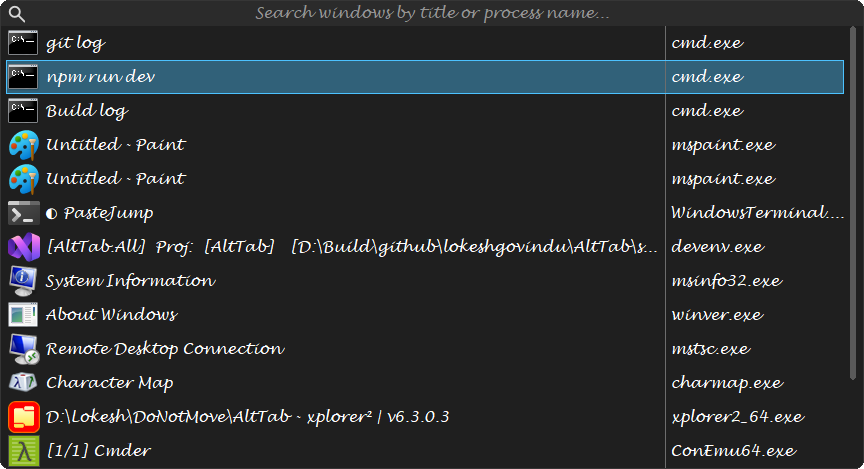
The window has two parts: a search box across the top, and the list of windows under it. It opens centred on one monitor, sized as a percentage of that monitor, and is only ever as tall as the rows it has.
The search box
Type into it to narrow the list — you do not have to click it first, and you do not have to let go of Alt. It has a magnifier on the left and, once there is something to clear, a × button on the right.
The placeholder text, the font and the two colours are all settings; see Appearance and themes. The box can be switched off entirely ([General] ShowSearchString), in which case typing still filters and the text simply is not shown.
The list
One row per window, in most-recently-used order, so the window you were in before this one is second and is what the switcher selects when it opens. That is why tap Tab and release swaps between two windows.
Each row has the application's icon, the window's title, and — if [General] ShowColProcessName is on — the executable's name in a column of its own.
- The selected row is highlighted. Arrows, Tab and the mouse all move it; Enter, a click, or releasing the hotkey's modifiers activates it.
- A row whose window is not responding gets its own background colour (
[ListView] NotRespondingBackgroundColor), so a hung application is visible before you switch to it. The selected row keeps the selection colour, or it would stop being legible. - A window being closed fades and slides out over
[General] RowCloseAnimationMs, rather than vanishing between one refresh and the next.
The list refreshes about ten times a second, so windows that open, close or change title while the switcher is up are picked up without you doing anything.
Scrolling
When there are more rows than fit, a thin scrollbar appears down the right-hand side. It is AltTab's own — the system's is 16 or 17 pixels wide, which is heavy next to these rows — and it pages when you click the track, drags, and follows the mouse wheel. When everything fits there is no scrollbar at all and the list uses the full width.
The wheel scrolls the switcher wherever the pointer is, including over the search box.
The window does not shrink while it is open
Filtering changes how many rows there are on every keystroke. The switcher grows if it needs to, but it never shrinks while it is on screen: the size it opened at is a floor. If it shrank, the rows would move out from under the pointer as you typed, and closing a window from the switcher would move everything at the moment you were clicking. The empty strip under the last row of a narrowed list is that decision showing.
The mouse
| Move over a row | Selects it, and outlines it if [MouseHover] ShowHighlightRect is on. |
| Rest on a row | Shows the information tooltip, after [MouseHover] TooltipDelayMs. |
| Click | Activates that window and closes the switcher. |
| Click the × on a row | Closes that window and leaves the switcher open. |
| Shift+click the × | Ends that window's process. |
| Right-click | The row's context menu. |
| Wheel | Scrolls the list. |
The information tooltip
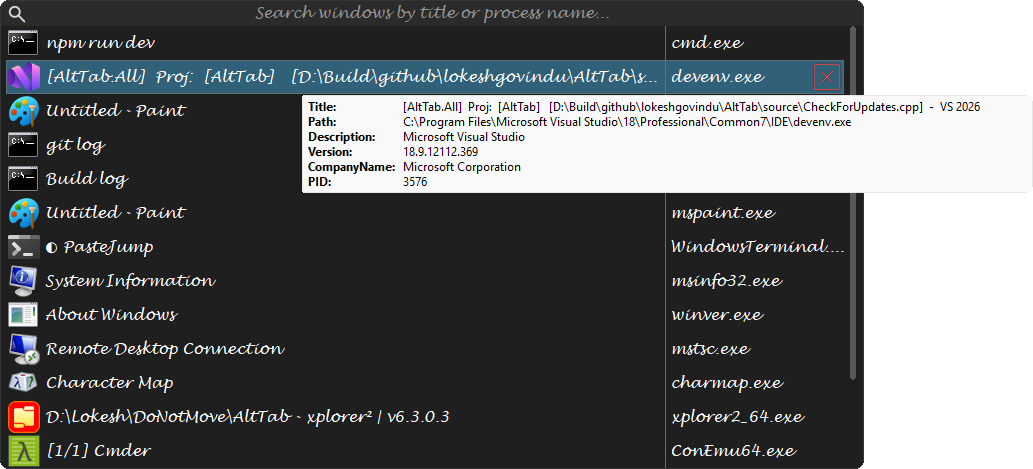
Rest the pointer on a row and it describes the window: title, full path, description, version, company and process id, plus Status: Not responding where that applies. Blank fields are left out rather than shown empty — an elevated process seen from a switcher that is not elevated has no readable path, and Path: with nothing after it looks like a fault.

Two details are deliberate. The pointer has to have moved before any tooltip appears: the switcher is opened from the keyboard and lands wherever the pointer already was, so a row can be "hovered" without anyone having pointed at anything, and a tooltip covering the list is not what a person reading it wants. And a keystroke puts them away until the pointer moves again, so tapping Tab does not trail tooltips behind it.
Turn it off with [MouseHover] ShowProcessInfoTooltip; change the wait with [MouseHover] TooltipDelayMs (0 shows it as soon as the pointer reaches a row — the movement rule still applies). [MouseHover] BoldTooltipLabels decides whether the labels are bold; the values beside them never are, because a table where every line weighs the same gives the eye nothing to run down. All three are on the Mouse page.
The close button
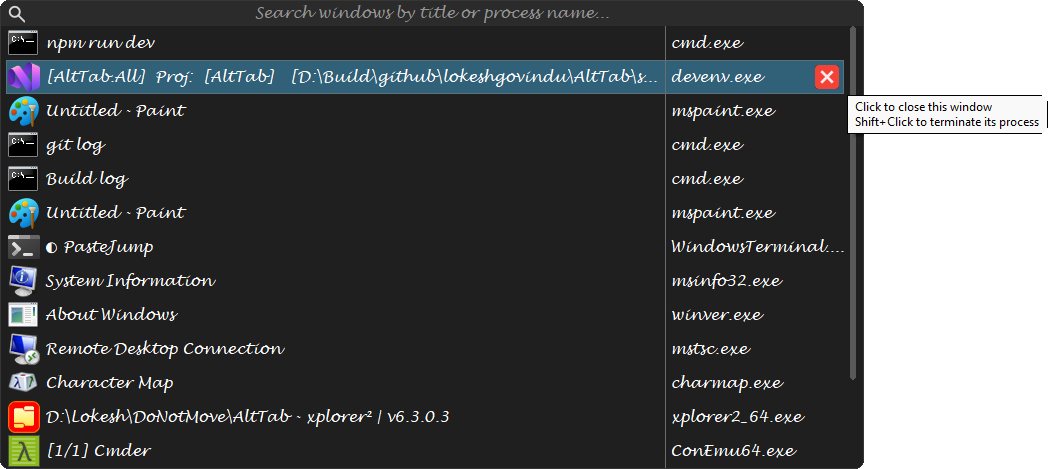
With [MouseHover] ShowDeleteButton on, the row under the pointer gets a × at its right-hand end. Clicking it closes that window without closing the switcher, so several windows can be closed one after another. Shift+click ends the process instead — see Closing and terminating for the difference.
The button has its own one-line tooltip, which replaces the row's while the pointer is on it.
The context menu
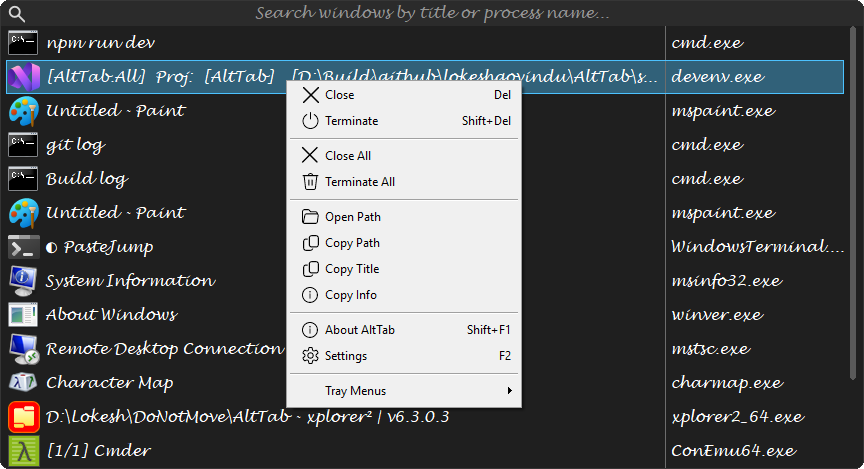
Right-clicking a row gives you everything that can be done to it:
| Close (Del) | Ask the window to close. |
| Terminate (Shift+Del) | End the process. |
| Close All / Terminate All | The same, to every window in the list. Asks first, unless you have turned [General] PromptTerminateAll off. |
| Open Path | Opens the folder the executable is in. |
| Copy Path / Copy Title | To the clipboard. |
| Copy Info | Everything the row's tooltip shows -- title, path, description, version, company and process id -- as lines of Key: value. What to paste into a bug report. |
| About AltTab (Shift+F1), Settings (F2) | |
| Tray Menus | The tray icon's menu, without going to the tray. |
The switcher stays open behind the menu, and closing the menu leaves it as it was.